For each of my photos taken of the fan, I had an F stop number of 4 and a ISO of 640. I set each of these manually to ensure a had the correct balance to make sure my photos were not either under or over exposed.
Theses photos demonstrate a slow shutter speed of 1/13 of a second. I didn’t use a flash on these photo as the extra light was not needed. The photograph has captured the blur of the fans movement. However, they do not demonstrate a range of colour and therefore do not fit in with the brief which focuses on shape and colour.


The above photos had a black background which allows the fan to stand out. The photos was taken inside however the only light source was the natural light though a near by window.
To ensure I had photos that met the criteria, I moved a lit match surrounded by tinfoil to show a slow shutter speed (shown below). For these photos, I had an ISO of 800 due to the dark surroundings, a F Stop of 29, and a shutter speed of five seconds. The long shutter speed meant that the full movement of the match was captured creating a photo that resembles the strokes of an aflame paint brush.


These photos showcase a high contrast between the burning orange of the flame and the darkness of the black background. My favourite of the shots captured is the below photo; this is because it has an interesting shape which resembles a flower. I like that it is the only subject in the photo meaning it is the main focus. Also, the burning lines create a layered effect as the lines build up to become bigger and brighter.
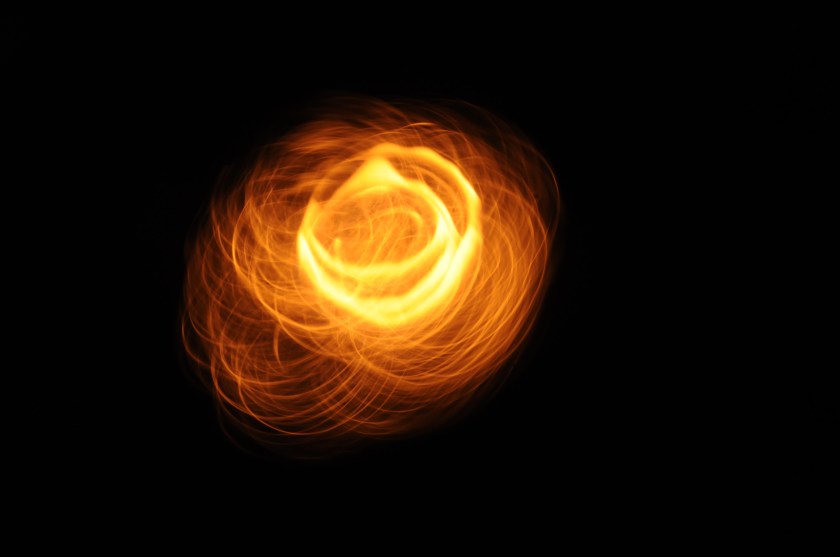
The photo was taken at night, indoors so that there was no external light as this meant that the only light source was the subject of the photo. The tinfoil used created the thinner lines by reflecting the light of the flame in many different places.
These photos demonstrate a fast shutter speed of 1/200 of a second, with the flash light. The fast shutter speed captured a frame of the movement of the fan, this showed the colour of the fan which was not seen in the previous photos using a slow shutter speed.


I used a black background for these photos as it helped the colours to stand out. The photos were taken in the same place as the others, with the same main light source however I also used the built in flash on the camera to add the extra light needed.
I like these photos due to the colours of the fan, the contrast of the blue and green against the black background makes for an interesting photo.


The above photos are also an example of a fast shutter speed. These photos were created using water and droplets of food colouring. The fast shutter speed was able to catch the flow of the colouring spreading through the water.
These photos were my favourite due to the combination of the blending colours and the shape of the blue food colouring. I like that the burst of colour against the plain white background. I chose these two colours due to them being opposite on the colour wheel; opposites on the colour wheel are complementary colours, they make one seem brighter when next to another.
I also took part in a speaker experiment which demonstrates a fast shutter speed. They were made using flour, coloured milk and cream on a powerful speaker which caused the materials to move and bounce. These photos used a shutter speed of 1/500 of a second, an F stop of 5.6, and an ISO of 1600.
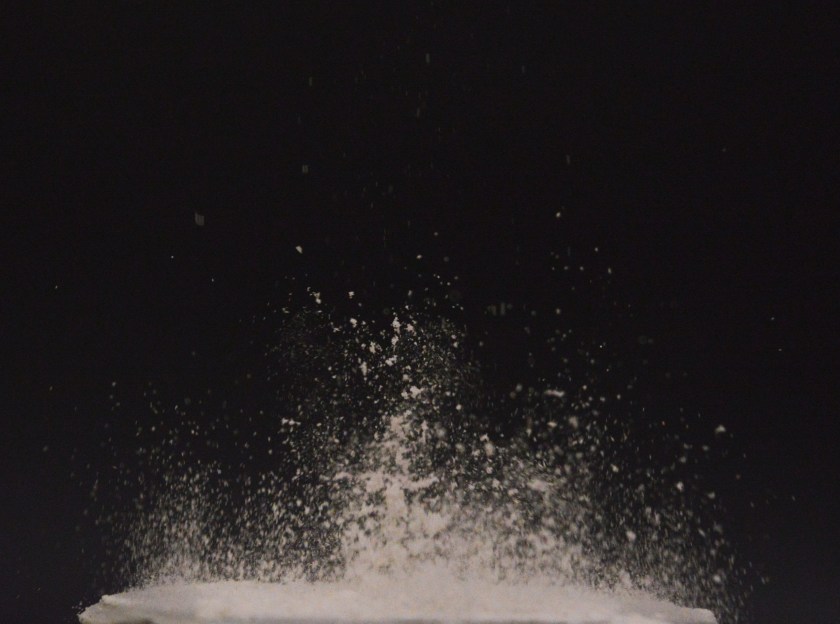
This is my favourite shot from this activity. It shows the bursting movement of the white flour that stands out against the dark background. I like the dimensions created in the photo by the differing brightness and focus in the areas of flour further from the camera. The photograph was taken using the natural light coming through a nearby window, however i think the photo would have benefitted from using the flash.
 Nicole Wood L3 photography